An indispensable underlying technology provider of organic semiconductors.
OM Sciences Company Limited: Pioneering Organic Polymer Electronics
OM Sciences is a global leader in organic polymer electronics, specializing in research, engineering, and patented synthesis techniques for conjugated organic polymers. By developing advanced printable semiconductors, OM is shaping the future of electronics with groundbreaking solutions for sensors, printed electronics, and other applications.
Applications of Printable Organic Conjugated Polymer Sensors
• Medical Applications: Learn more
• Agricultural Applications: Learn more
please click to see an Agricultural AIoT company OM working with
• Hybrid Electronics: Learn more
• Overview of Printed Electronics: Learn more
OM focuses on sensor innovation, addressing growing demands in areas like patient monitoring and security. Its printable semiconductors feature low power consumption, flexibility, stretchability, and IoT/AIoT compatibility, enabling transformative advancements such as Air Gesture Control and other cutting-edge technologies.
OM’s core expertise lies in organic conjugated polymer synthesis and post-modification, enabling chemical adjustments to customize polymers for diverse applications—a flexibility unmatched by inorganic materials. The company refines conductive polymers for high performance and versatility, supporting fields like medical and agricultural sensing, hybrid electronics, and printed electronic components.
OM is committed to building a library of organic conjugated polymer semiconductors for licensing, fostering innovation and commercialization. By leveraging precise control over nanoscale properties, OM develops responsive polymers for advanced applications in sensing, separation, and more, aiming to deliver exceptional returns for stakeholders and drive progress in the organic electronics industry.
It is also worth mentioning that conjugated polymers also have a potential application organic solar cell (OSC). An organic solar cell (OSC) or plastic solar cell is a type of photovoltaic that uses organic electronics, a branch of electronics that deals with conductive organic polymers or small organic molecules, for light absorption and charge transport to produce electricity from sunlight by the photovoltaic effect. Most organic photovoltaic cells are polymer solar cells. Learn more
Business Model: Franchise Organic Conjugated Polymer Electronic Technology Transfer in China
“Great Bay Area is the only region in the world where Megatronics technology and AI technology simultaneously reside. “ – by NVIDIA Founder Jensen Huang Dec. 2024 at HKUST.
OM Sciences is partnering with a Hong Kong family office to establish a franchise model for transferring its proprietary organic conjugated polymer electronic technology to local businesses in China and abroad. This initiative aims to enable regional manufacturing, promote application development, and foster market growth in the region.
Business Structure
- Franchise Model: Licensing patented organic polymer technologies to franchisees across China and abroad.
- Technology Transfer: Providing franchisees access to proprietary knowledge, training, and support for manufacturing sensors, conductive inks, and electronic components.
Revenue Streams
- Initial Franchise Fee: Licensing rights and technology transfer setup.
- Royalties: Share of revenue from franchisee product sales.
- Product Sales: Supplying essential raw materials like printable organic conjugated polymer ink.
- Training and Consulting: Paid programs ensuring quality and innovation.
Competitive Advantages
- Cost Efficiency: Manufacturing at ambient conditions reduces energy costs.
- Localized Manufacturing: Leverages regional resources for cost-effective production.
- Customizability: Franchisees can adapt OM’s polymers for applications such as IoT/AIoT devices, Food Supply Chain Monitoring, Security Checking, Healthcare sensors and many more.
Implementation Plan
- Launch a pilot franchise in Tier-1 cities like Shenzhen or Shanghai.
- Gradually expand to Tier-2 and Tier-3 cities to establish a nationwide network.
- Partner with local governments, universities, and industries to drive adoption.
This franchise model accelerates technology dissemination, drives revenue growth, and positions OM Sciences as a leader in organic electronics market.
Quote: “OM prime focus is on sensor applications and the road map is to perfect the printable electronic components. Colleagues from other applications worldwide could eventually meet and shape the future printable electronics and other components.” by Professor Ngai Sai Ming founder of OM.
● Chairman

Prof. NGAI Sai Ming (PhD) (over 20 years exp.)
Professor, School of Life Science, CUHK
Expert in proteomics, metabolomics and mass spectrometry
Patent holder
Quote: “OM masters the key technologies of organic conjugated polymer semiconductors synthesis and post-modification of organic electronic materials. In other words, when a new polymer is invented and has certain applications, the polymer’s backbone can be chemically modified to produce a range of different derivative polymers. This kind of modification of inorganic materials is basically impossible. In other words, when a new organic semiconductor is invented and has certain applications, the main chain of the organic semiconductor can be modified through chemical methods to obtain a series of different derivative organic semiconductors. It is basically impossible to carry out such modifications on inorganic semiconductors. This saying, OM is inventing conducting polymers which have improved properties and are suitable for a wide range of applications.” By OM Chief Technology Officer Dr. NGAI Jenner, Ho Loong (PhD).
Quote: “At nano to microscopic level such that OM can control their swelling behavior, their construction, misolicitation or equilibration at the interface. So, when we say similar responsive polymers on stimuli that can be applied whether by temperature, pH, magnetic field, in turn this will elicit a response on the polymer that results in change in shape mechanical properties permeability of a separation optical and electrical properties as well. “By OM Chief Technology Officer Dr. NGAI Jenner, Ho Loong (PhD).
● Chief Technology Officer

Dr. NGAI Jenner, Ho Loong (PhD) (Over 10 years exp.)
Organic Synthesis / Polymer Chemistry / Chemical Engineering
Innovative Organic Semiconducting Polymer Development by OM Sciences
OM Sciences has pioneered proprietary fabrication processes for organic semiconducting polymers, synthesizing 8 donor and 7 acceptor polymers. These donors and acceptors, which serve as the foundation for logic gates, are critical for creating advanced electronic structures such as logic circuits, integrated chips, and printable electronics. OM focuses on enhancing organic-based sensor materials for applications in detecting organic volatiles, pressure, humidity, and temperature. With unprecedented physical properties, these 8 donors and 7 acceptors offer 56 potential combinations yet to be fully explored. Learn more about OM’s synthesized organic electronic chemicals and building blocks here.

Conductive polymers can exhibit varying conductivity based on their intrinsic properties, customized synthesis, or composite structures. This adaptability enables countless combinations to fine-tune conductivity, offering far greater versatility than traditional semiconductors. Furthermore, synthetic approaches allow precise tailoring of chemical functional groups for high selectivity and performance—features not achievable with inorganic materials. OM’s patented expertise lies in tuning organic polymers into printable, flexible electronics tailored to specific client applications. The company is currently focused on sensor innovation. Discover how OM synthesizes polymers into semiconductors here.
Innovative Fabrication of Organic Polymer Electronics by OM Sciences
At OM’s laboratory in the Hong Kong Science & Technology Park, organic conjugated polymer electronics are processed under normal ambient conditions, from raw materials to finished products. Unlike conventional inorganic electronics, which require vacuum chambers, and fabrication temperatures up to 1,000°C for silicon and metal-based components, OM’s approach is significantly more cost-effective. Traditional methods also rely on rare earth materials, which generate toxic byproducts and incur high costs. OM’s technology transfer to conventional manufacturers offers substantial savings and efficiency improvements.
OM’s research team specializes in developing new conjugated polymers for diverse applications. Over the past decade, π-conjugated materials have been successfully commercialized in products such as OLED displays for phones and screens, and anti-corrosion coatings for metals. OM’s expertise in band gap tuning enables precise modification of energy levels in conjugated materials to create active materials tailored for specific applications. This engineering approach supports the development of lightweight, high-performance, solution-processable materials for today’s electronics industry.
Solution processing is a key feature of organic electronic materials, allowing the production of “conductive inks” for fully printable electronics. These inks can be deposited onto substrates through simple printing or coating techniques, eliminating the need for energy-intensive setups required for traditional methods using inorganic materials like metals or metal oxides. By processing organic polymer electronics under ambient conditions, OM significantly reduces production costs while supporting a more sustainable, environmentally friendly manufacturing process. This innovative approach eliminates the complexities of conventional fabrication, offering a greener and more economical solution for the electronics industry.
OM Sciences: Bridging Organic Polymer Technology and Semiconductor Industries
OM Sciences is dedicated to transferring its groundbreaking organic semiconductor technologies to the electronics industry, enabling transformative advancements at minimal costs.
1. Collaboration with Conventional Electronics Manufacturers
o OM helps manufacturers integrate organic polymer electronics using their existing facilities and equipment at significantly reduced costs.
o OM’s ambient production processes eliminate the need for high temperatures, rare earth materials, and energy-intensive setups.
o Hybrid solutions combining OM organic conjugated polymer sensors with conventional electronics create innovative, cost-effective products.
2. Inventing New Semiconductor Solutions
o OM develops novel organic conjugated polymer semiconductors tailored for modern and traditional electronic applications.
o These materials feature low power consumption, flexibility, printability, conformable, stretchability, biocompatibility, and IoT/AIoT compatibility, offering unprecedented possibilities.
o OM’s wireless-compatible sensors transmit signals via Wi-Fi and Bluetooth, ensuring seamless connectivity.
o OM is an organic conjugated polymer printable electronics solution provider and fundamental materials provider.
3. Licensing Technology
o OM offers licensing opportunities for its patented conjugated organic polymer semiconductors, providing partners with access to advanced, protected technologies.
OM’s Edge: Leading the Organic Electronics Revolution
OM Sciences employs cutting-edge techniques to fabricate electronic sensors and devices using eco-friendly materials, avoiding heavy metals and energy-intensive processes. OM’s patented printable electronic materials allow partners to create innovative solutions with peace of mind.
Key Applications and Innovations:
• Printable Sensors
OM’s materials enable sensors to be deposited on substrates like paper, fabric, or plastic films through simple printing or coating at ambient conditions.
• Medical and Agricultural Monitoring
Sensors are AIoT-compatible, enabling advanced patient monitoring and precision agriculture. Explore OM’s partnership with AIoT agriculture client here. OM is also talking to medical schools’ researchers in this area of development.
• Security Solutions
OM develops sensors for security checkpoints (airports, customs, stadiums, schools) capable of detecting drugs, explosives, signals, and chemical fingerprints. These sensors “smell,” “hear,” and “see” beyond traditional limits, enhancing security measures globally.
• Next-Generation Electronics
OM specializes in creating flexible, stretchable, and aesthetically integrated materials for foldable and portable electronics, addressing the demand for new form factors. Printable electronics offer freeform designs, enhancing device functionality and integration.
Unmatched Cost Efficiency and Flexibility
OM’s organic polymer electronics eliminate the challenges of traditional silicon-based electronics manufacturing:
• No need for vacuum chambers or high-temperature setups (up to 1000°C).
• Reduced costs through ambient processing conditions.
• Hybrid solutions that combine cost-effective organic materials with conventional electronics.
OM’s sensors are uniquely sensitive across multiple modalities—touch, smell, vision, taste, and hearing—opening doors to applications previously deemed impossible. With continuous improvements in materials and processes, OM is committed to helping partners deliver superior products while reducing costs and environmental impact. Utilizing OM laboratory’s research breakthroughs significantly enhances production capacity, lowers costs, and improves product functionality. OM offers advanced sensors for detecting organic volatiles, pressure, humidity, and temperature. Additionally, its innovative approach of using sensor substrates as encapsulants simplifies the encapsulation process.
OM’s patented expertise lies in customizing organic polymers into printable, flexible electronics, precisely tailored to meet the specific requirements of various client applications.
The Advancements and Potential of Organic Semiconductors
Ease of Fabrication and Versatility
Organic conjugated polymers offer superior performance and tunable conductivity, enabling innovative applications in electronics. OM Sciences specializes in tailoring these materials for advanced uses, including OLEDs and Organic Photovoltaics (OPVs), which provide sustainable, flexible energy solutions. Their low power consumption and ability to self-power under ambient light make them ideal for sensors, biosensors, and IoT/AIoT applications.
Comparison with Inorganic Semiconductors
Organic semiconductors are more energy-efficient and cost-effective than silicon-based counterparts. Unlike traditional methods that require energy-intensive facilities and generate toxic waste, organic semiconductors are manufactured through simple processes like printing and drop-casting. They utilize eco-friendly raw materials, making them a greener alternative to inorganic semiconductors.
Industry Applications
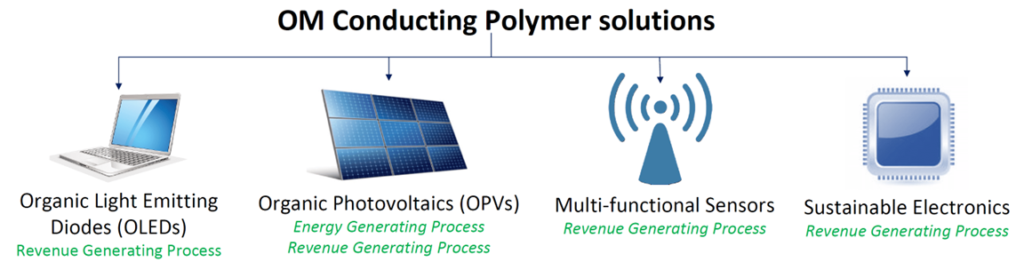
Organic semiconductors are lightweight, flexible, and cost-efficient, with applications in OLEDs, OFETs, and sensors. They enable fine-tuning of material properties, such as band gap adjustments, to support low-cost fabrication. Their biodegradability and sustainability further enhance their appeal across industries.
OM Sciences’ Contributions to Transistor Technology
OM Sciences excels in fabricating thin-film transistors (TFTs) using printing methods, achieving mobility values up to 1 cm²/V·s. Tests on the polymer N2200 validated the material’s quality and demonstrated the potential for advanced applications, even under suboptimal conditions.
Advantages of OM’s Approach
Conclusion
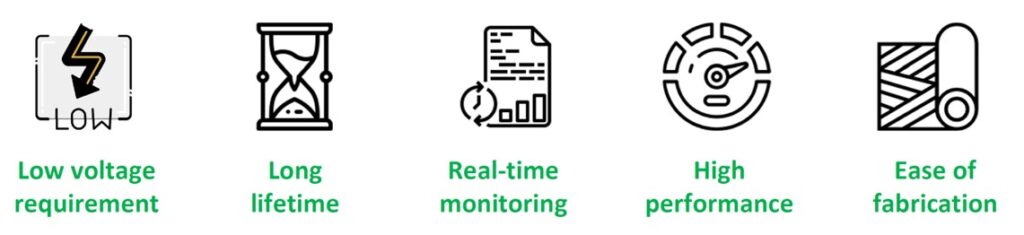
Organic semiconductors offer unmatched flexibility, sustainability, and cost-efficiency. OM Sciences leads the way in developing innovative materials and technologies for a wide range of modern applications.