Nobel Prize Awarded History and Advancements in Organic Conjugated Polymer Electronics
In the 1960s, semiconductor technology advanced rapidly, primarily using inorganic materials like silicon and rare earth-based oxides. Manufacture under high temperature (1000°C+) requires vacuum chamber since the use of toxic metal oxides. Organic semiconductors were underexplored until 1973, when John Edward McGinness proposed their potential. This concept was later developed by Nobel laureates Alan J. Heeger, Alan G. MacDiarmid, and Hideki Shirakawa in 2000, laying the foundation for organic conjugated materials. These materials enable charge transport via π-bonding and quantum mechanical wave functions, influenced by energy gaps, temperature, and electric fields. A process known as frequency-hopping transport, which depends on the energy gap between HOMO and LUMO levels. And the synthesis is under ambient conditions, gives big cost saving.
Unlike traditional polymers with large band gaps acting as insulators, semiconducting polymers can adjust their band gaps using donor and acceptor monomers, offering tunable electrical properties. Over the past decade, π-conjugated materials have been applied in OLED displays, anti-corrosion coatings, and printable electronics. Band gap tuning has allowed the creation of lightweight, flexible, high-performance solutions like conductive inks for advanced fabrication.
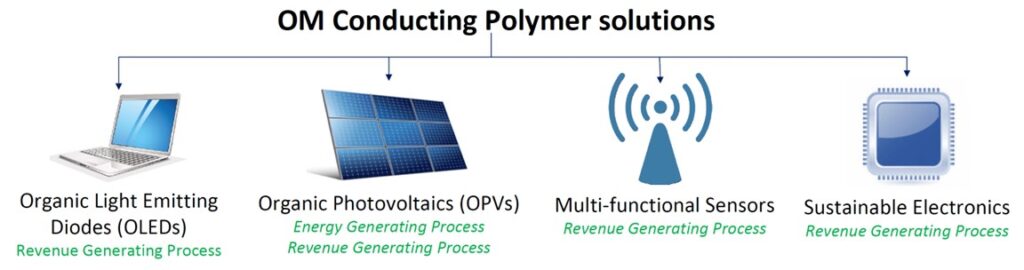
Conjugated polymers hold vast potential in emerging fields such as organic solar cells (OSCs), organic field-effect transistors (OFETs), wearable electronics, artificial organs, and high-sensitivity sensors. OM Sciences leads in developing these materials, leveraging expertise in organic synthesis to create advanced functional materials and drive the future of organic electronics.
