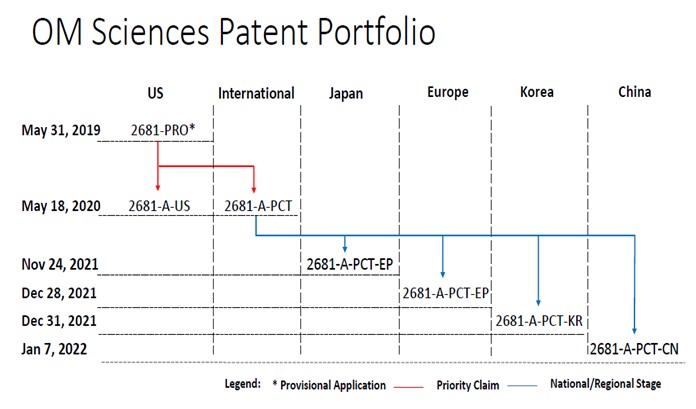
OM patent – United States Patent Application Publication Ngai Pub. No.: US 2024/0067773 A1
OM’s unique patented competency is to tune organic polymer to become a specific organic printable and flexible electronic to fulfill client’s specific electronic application. And OM is currently sensor centric. Please see OM’s IP below which you cannot find elsewhere. Share your dream with OM, OM will walk you there. Click Here to see OM patent
United States Patent Application Publication Ngai Pub. No.: US 2024/0067773 A1
Abstract
This invention relates to compositions of conducting polymers and their producing methods and applications in sensing technology. The present conducting polymer comprises an electron deficient and an electron rich building block in an alternated repeating unit which can function as sensors to detect, qualify or quantify analytes in fluid and exhibit chemiresistive property and stable performance in normal room temperature and air pressure. In one embodiment, the present invention provides compositions of conducting polymers and devices comprising the present compositions or conducting polymers for sensor application. In another embodiment, the present invention provides methods of detecting target molecules using compositions, conducting polymers or devices of the present invention. The target molecules include without limitation volatile organic compounds (VOCs) which are indicative of the presence or stage or a disease, or indicative of the health status of a subject.
Field of the invention
This invention in general relates to organic conducting polymers and their uses in devices and methods for detecting molecules.
Background of the invention
The energy difference between the two bands (Highest Occupied Molecular Orbital – HOMO known as VB valence band AND Lowest Unoccupied Molecular Orbital – LUMO known as CB conduction band) is known as the band gap. Different materials may have different band gaps and energy levels. In organic electronics, chemists make use of synthesis techniques to design and create organic electronic materials with various band gaps and energy levels by adding different functional groups to the materials and can be further modified by adding different dopants, ranging from organic solar cells or organic photovoltaics (OPVs), organic light emitting diodes (OLEDs), organic field-effect transistors (OFETs), batteries, sensors and so on. Conducting polymers have a chemiresisive property which means their electrical resistance is sensitive to chemical environment, this allow them to function as sensors and be utilized in various detection technologies such as electronic noses or other detectors. The characteristics of Conducting polymers can be further modified by adding different dopants, and/or by altering their functional groups. This expands the scope of potential uses of Conducting polymers in multiple areas.
Summary of the invention
[0009] This invention relates to compositions of conducting polymers and their producing methods and applications in sensing technology. [0010] The present invention provides compositions of conducting polymers for sensor applications. [0011] The present invention further provides methods of detecting target molecules using compositions, conducting polymers or devices of the present invention. The target molecules include without limitation volatile organic compounds (VOCs) which may be indicative of the presence of stage or disease, or indicative of health status of a subject.
Remarks
The present invention provides new classes of conducting polymers which have properties, their manufacturing methods and applications. The present conducting polymers have notable advantages over currently available conducting polymers such as improved chemiresistance, thermal and ambient stability, and other electronic and chemical properties, and can be applied to wide variety of technologies related to sensing or detection of molecules or other electronic aspect such as transistors, solar cells, batteries, anti-static coating, and infrared detector.
The conducting polymers of the present invention are soluble in organic solvents; stable in room temperature, pressure and humidity, and only require a low working voltage. Therefore, sensors constructed using the present polymer can function at room temperature and require only a very small voltage (1V). Furthermore, its high solubility in organic solvents makes the synthesis of the present conducting polymers easier. Fabrication of the sensors using the present conducting polymers is also easier and more flexible. For instance, sensors can be printed on different surfaces using appropriate printing devices, these expand the industrial applications of the present conducting polymer comprises thermally or acid cleavable chemical components which is capable of producing a highly cross linkable thin film of small thickness such as 10-100 nm, The thin film has high chemical resistance and is resistant to various chemicals such as chloroform, acetone, methanol, toluene, chlorobenzene, dichlorobenzene, mineral acids and water.
[0096] The present conducting polymer is soluble in a wide range of organic solvents and can be used to prepare conductive ink comprising the organic solvent and the conducting polymer.
remarks
(Production methods such as eletropolymerization are not efficient since a large portion of raw materials are usually wasted during the process and also time consuming, the low solubility in organic solvent further complicates the synthesis process and make it tedious and inefficient.)