OPV refer to Organic photovoltaic
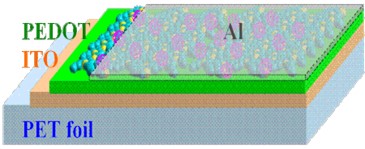
An organic solar cell (OSC[1]) or plastic solar cell is a type of photovoltaic that uses organic electronics, a branch of electronics that deals with conductive organic polymers or small organic molecules,[2] for light absorption and charge transport to produce electricity from sunlight by the photovoltaic effect. Most organic photovoltaic cells are polymer solar cells.
Compared to silicon-based devices, polymer solar cells are lightweight (which is important for small autonomous sensors), potentially disposable and inexpensive to fabricate (sometimes using printed electronics), flexible, customizable on the molecular level and potentially have less adverse environmental impact. Polymer solar cells also have the potential to exhibit transparency, suggesting applications in windows, walls, flexible electronics, etc. An example device is shown in Fig. 1. The disadvantages of polymer solar cells are also serious: they offer about 1/3 of the efficiency of hard materials, and experience substantial photochemical degradation.[5]
Polymer solar cells’ stability problems,[6] combined with their promise of low costs[7] and potential for increasing efficiencies[8] have made them a popular field in solar cell research. In 2015, polymer solar cells were achieving efficiencies of more than 10% via a tandem structure.[9] In 2023, a new record-breaking efficiency of 19.3% was achieved by Hong Kong Polytechnic University.[10]
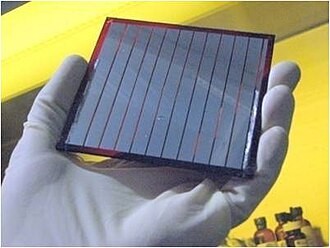
Collaborating with OM OPV breakthrough, OM promises a higher organic photovoltaic cells efficiency.
Organic Photovoltaic electronic materials designed and synthesized by OM Sciences
| Polymer | Status | Class of Material | Organic Electronics Application |
| P3HT | Available | p-type | Organic photovoltaics, Polymer solar cells, OLEDs, OFETs |
| PDQT | Available | ambipolar | Transistors, Organic photovoltaics, Polymer solar cells, OFETs |
| N2200 | Available | n-type | Transistors, Organic photovoltaics, Polymer solar cells, OFETs |
| DPP-DTT | Available | ambipolar | Organic photovoltaics, Polymer solar cells, OFETs |
| PDNI-T | Available | n-type | Transistors, Organic photovoltaics, OFETs |
| DPPDPyBT | Available | ambipolar | Organic photovoltaics, Polymer solar cells, OFETs |
Advantages of Organic Photovoltaics (OPVs) Over Inorganic Conventional Photovoltaics
Organic Photovoltaics (OPVs) offer a range of advantages compared to traditional inorganic photovoltaics (e.g., silicon-based solar cells). These advantages are rooted in their unique properties, material composition, and manufacturing processes. Below are the key benefits:
1. Lightweight and Flexible Design
- Flexibility: OPVs are built on lightweight and flexible substrates, allowing them to be incorporated into a variety of applications, such as wearable devices, foldable electronics, and curved surfaces.
- Portability: Their lightweight nature makes them ideal for portable solar solutions, such as rollable solar panels and lightweight power sources for remote areas.
- Versatile Form Factors: Unlike rigid silicon panels, OPVs can conform to various shapes, opening possibilities for integration into everyday objects like clothing, vehicles, and building materials.
2. Low-Cost Manufacturing
- Solution Processing: OPVs can be manufactured using solution-based techniques like roll-to-roll printing and inkjet printing, which are much less capital-intensive than the high-vacuum and high-temperature processes required for silicon photovoltaics.
- Scalable Production: These processes enable large-scale, continuous production, significantly lowering per-unit costs.
- Use of Abundant Materials: Unlike silicon photovoltaics, which depend on expensive rare earth materials and purified silicon, OPVs rely on organic compounds that are often inexpensive and readily available.
3. Enhanced Sustainability
- Reduced Environmental Impact: OPVs use less energy during production compared to silicon cells, which require energy-intensive purification processes and high-temperature manufacturing.
- Non-Toxicity: Organic materials used in OPVs are generally less toxic than some components of inorganic photovoltaics (e.g., cadmium or lead in thin-film solar cells).
- Biodegradability: Research on biodegradable organic materials could enable eco-friendly disposal of OPV panels, reducing electronic waste.
4. Superior Performance Under Low-Light Conditions
- High Sensitivity to Diffuse Light: OPVs excel in capturing diffuse and low-intensity light, making them suitable for indoor applications, cloudy environments, and shaded areas.
- Broad Spectrum Absorption: The tunable properties of organic materials allow OPVs to absorb a wider spectrum of light, including wavelengths not efficiently utilized by silicon cells.
5. Customizability and Aesthetic Integration
- Color and Transparency: OPVs can be designed in various colors and levels of transparency, enabling integration into aesthetically sensitive applications such as architectural glass, windows, and decorative panels.
- Seamless Building Integration: Their flexibility and transparency allow OPVs to be incorporated into building materials, creating Building-Integrated Photovoltaics (BIPVs) for energy-efficient architecture.
6. Low Temperature and Energy Manufacturing Requirements
- Ambient Manufacturing: OPVs can be fabricated under ambient or low-temperature conditions, significantly reducing energy consumption during production.
- Elimination of Rare Earth Materials: By avoiding rare earth and high-purity silicon, OPVs eliminate the geopolitical and environmental challenges associated with sourcing these materials.
7. Potential for Energy Autonomy and Decentralized Usage
- On-the-Go Power: OPVs enable lightweight, portable energy solutions, making them ideal for personal devices, remote installations, and disaster-relief efforts.
- Off-Grid Applications: Their portability and ease of installation make them highly attractive for off-grid and rural applications.
8. Rapid Innovation and Scalability
- Tunable Properties: The molecular structure of organic materials can be engineered to optimize properties like light absorption, charge mobility, and stability, enabling rapid development of more efficient and durable OPVs.
- Lower Barrier to Entry: The simplified manufacturing process makes OPV production more accessible to smaller companies and startups, accelerating innovation and market competition.
Challenges Being Addressed
While OPVs have several advantages, challenges such as efficiency, lifespan, and long-term stability are being addressed through advancements in materials science, encapsulation techniques, and hybrid approaches (e.g., combining OPVs with inorganic elements).
In summary, OPVs offer unparalleled flexibility, sustainability, and versatility compared to conventional inorganic photovoltaics. Their potential for cost reduction, aesthetic integration, and superior performance in specific conditions makes them a transformative technology for the future of renewable energy.